
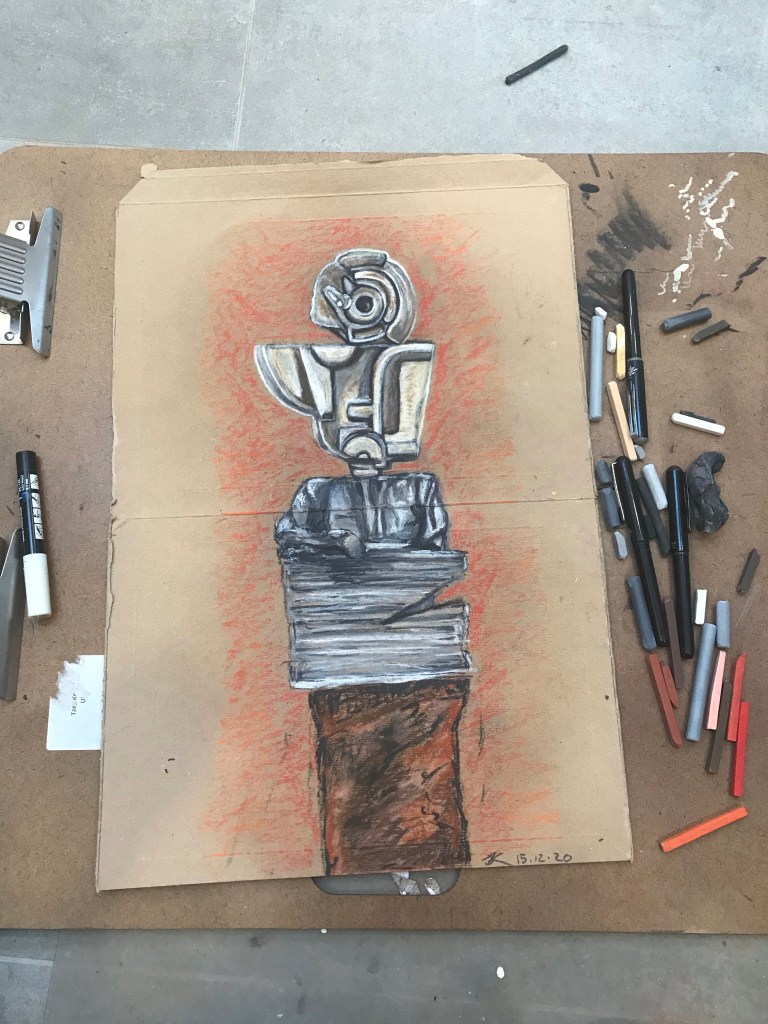
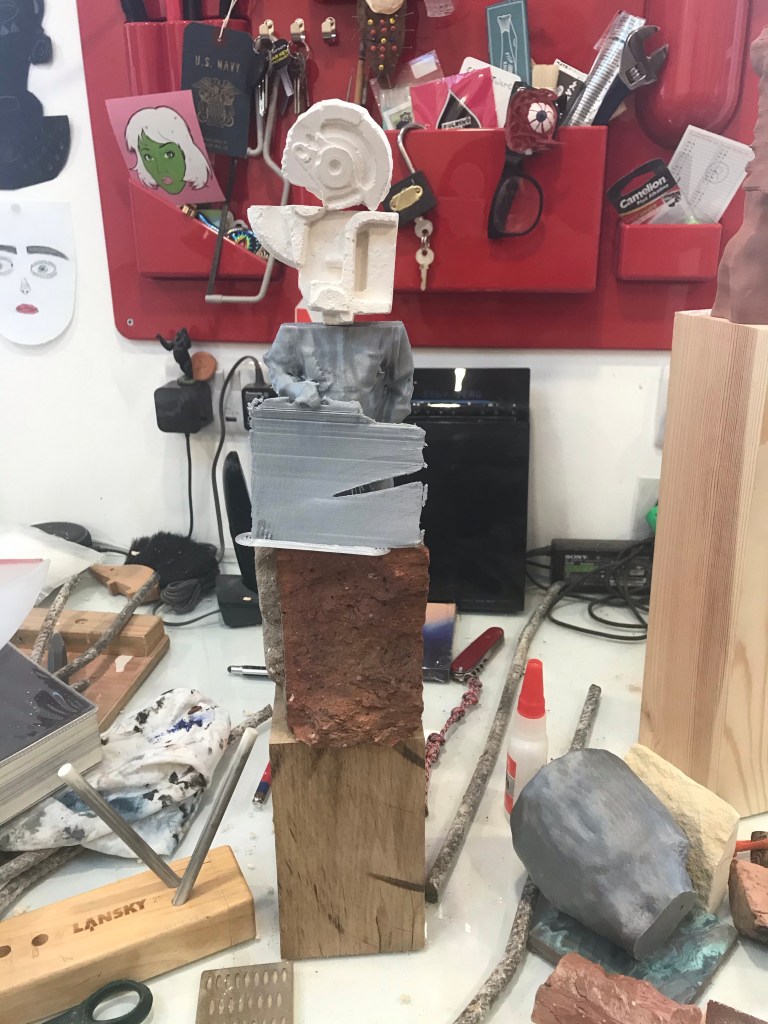
Recently I have come into the possession of some plaster casts from the disbanded studio of Eduardo Paolozzi. At first I was a bit unsure about their providence as I had brought them off a dealer on eBay, let’s admit they don’t look anything special, they came in a box with a scanned letter of authentication but anyone could fake that. So what drew me to these items? really it was the shapes and the knowledge that over many years Paolozzi had amassed and cast many of these plaster forms.
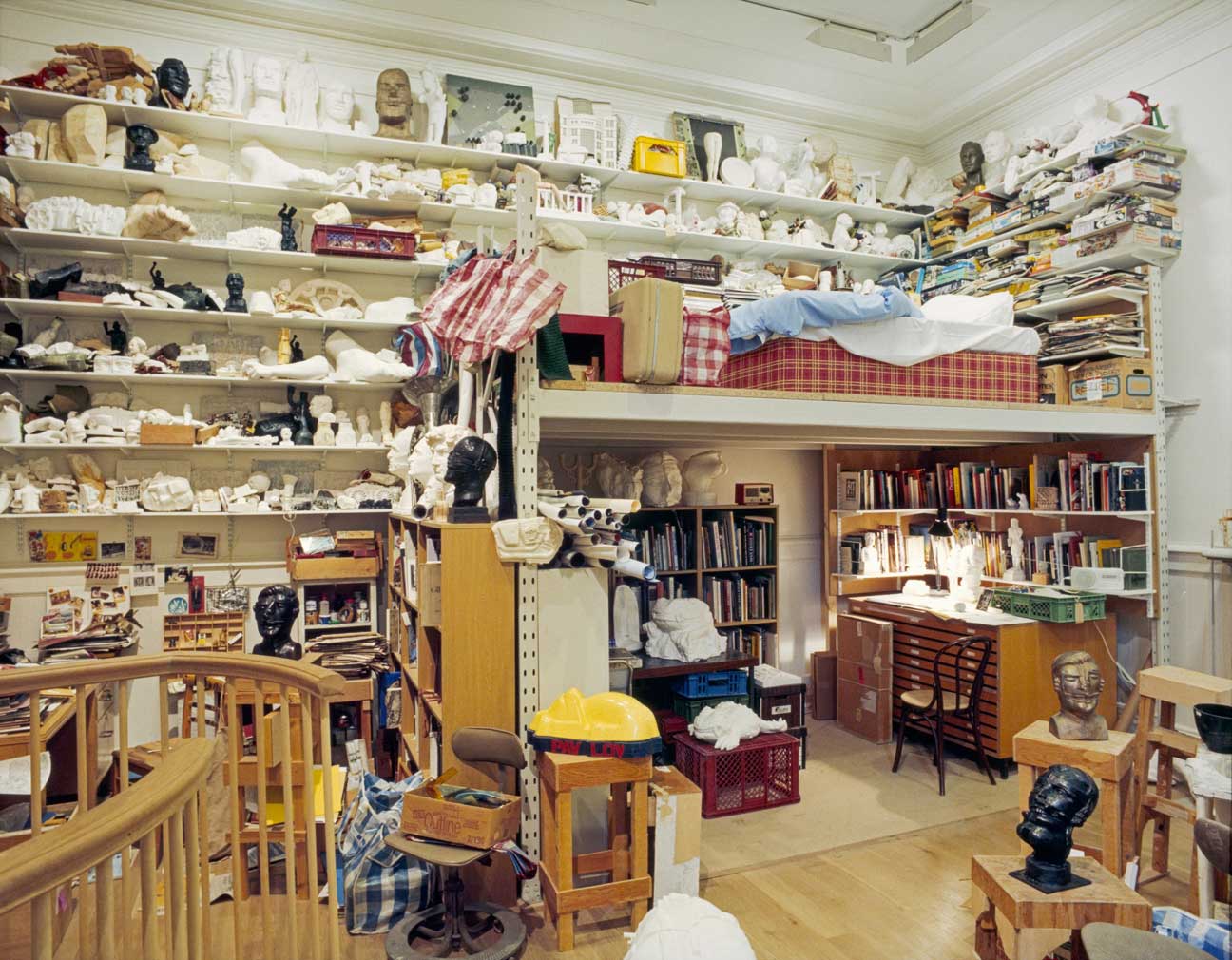
As I got more inspired by these forms, I gradually made contact with the dealer that sold them to me to see if he had any more, little did I know he has one of the biggest collections, He is Graeme Brooks a an artist in his own right and a big collector of Post War Art. In an Article online he talks about how he came into possession of the Paolozzi plasters.
“I had become aware of Marcus Campbell selling the contents of Paolozzi’s Chelsea Studio from his London Bookshop, so realising that this was a ‘one off’ art historical event ploughed all the money into plasters,”
Graeme then elaborates some more about the plasters “Both artists realised that Art is for All, and only resonates when seen, and thus made prolific variations and multiples all within the price range of most buyers. Both anti-elitists modestly and intentionally devalued the price of their own work by making too much, selling at public markets or simply giving away.“
“I have continued this mutually beneficial process by playing a small part in the targeted affordable dissemination of both these great artists life work, which has been a total pleasure and education.” ( comments from an online interview with Post War British and Graeme Brooks 2020 https://postwarbritish.co.uk/graeme-brooks-interview-part-1/)
And it was through this way that I stumbled upon these pieces for sale on eBay and have also started more of a Dialogue with Graeme.
Whilst researching to find out some more about Paolozzi’s fascination with plaster I came across this
Robin Spencer, the authority on Paolozzi, wrote about Paolozzi’s use of plaster:
“With regard to the small plasters, some are from ‘ready-mades’ (including boxed model kits, objects found in charity shops etc); others are cast from his own designs.The plasters from the 1990s were not often cast in any other material. A lot of the animals were made specially for the ‘Arche Noah’ , [Noah’s Ark], exhibition in Munich in 1990.”
“He was very keen that the medium of plaster should have a higher status as a sculptural medium than it had previously enjoyed in the 20th century. He took a particular interest in this question after Albert Elsen’s ‘Rodin Rediscovered’ exhibition (1981) which re-valued Rodin’s practice with plaster.”
Robin Spencer then elaborated some more about the importance of plaster to Paolozzi and his work practice
”Paolozzi’s approach, like that of Picasso and the Surrealists, often involved the use of found objects. His studio was filled with plaster casts of the objects that appealed to him – dolls, toys, machine parts etc.Sometimes these objects would simply be cast, at other times they were chopped up and reassembled, or individually coloured by the artist.As with Rodin’s approach to plaster, Paolozzi often regarded the plaster as the final work and most of Paolozzi’s plasters were never intended for casting or editioning.” (comments from http://www.blondesfineart.com/blondes-blog/eduardo-paolozzi-plaster-maquette-for-sale , November 21, 2017 unfortunately I can not find where this site got Robin Spencer’s quotes from)
But Why Working with Ghosts? well when receiving these artifacts I realised, I could be like most collectors and place them on a shelf to gather dust and fetischise them, or I could actually use them. So I have now started thinking about how I can integrate them within my own work as a collaboration between myself and the late Paolozzi.
Having been researching Paolozzi’s art practice I think he would be interested in this project. Had he had the technology to 3D scan and print items his work may have expanded in many other directions.
So hopefully once I am back in university I can make some silicone moulds of the plasters which I can then recast in plaster and cut up destroy and rebuild in to a new form, much like how Paolozzi would approach a sculpture. Making a collage of found and altered components to create a new sculptural form or language.
Finally Paolozzi has something to say about the word collage
” The word collage is inadequate as a description because the concept should include ” Damage, erase, destroy, deface and transform all parts of a metaphor for the creative act itself” ( Eduardo Paolozzi, ‘ Collage or a Scenario for a Comedy of Critical Hallucination”, in Eduardo Paolozzi: Collages and Drawings, exhibition catalogue, Anthony d’Offay, London 1977)
 The Art and musings of Jeffrey Knopf