
I expect research is all those things I do all the time, I’m always looking at books for inspiration, books about art art movements books about ethnography the thing is I’m so used to doing this but I don’t really reference it in a written form I’m sure you can see the subconscious influences in my art practice. anyway through my research and. the way I’m currently working I found myself taking an interest in. the working practice of Henry Moore.
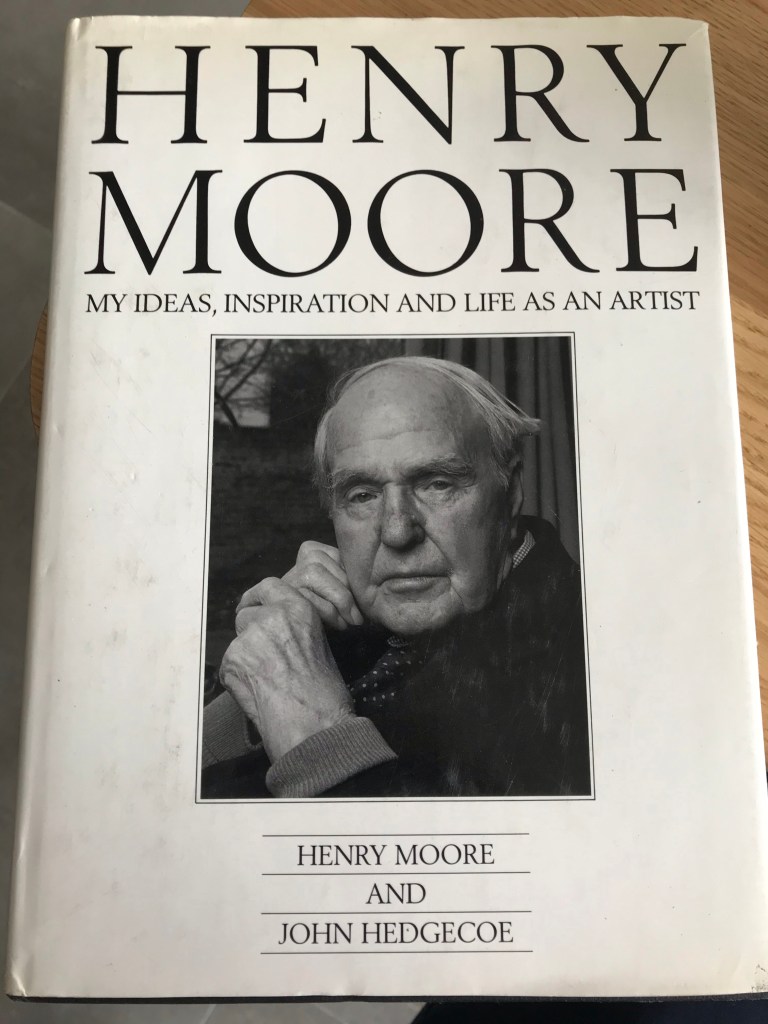
I have to be honest I have never really been that interested in the work of Henry Moore, maybe that’s because his work had become so much a part of the 20th century landscape, but strangely whilst carving out my mortar sculptures Hallie Moore has been in my mind, mainly because of a book I came across at a friends house many years ago. So. I tracked this book down to is called Henry Moore my ideas, inspiration and life as an artist written by Henry Moore with photos by John Hedgecoe.
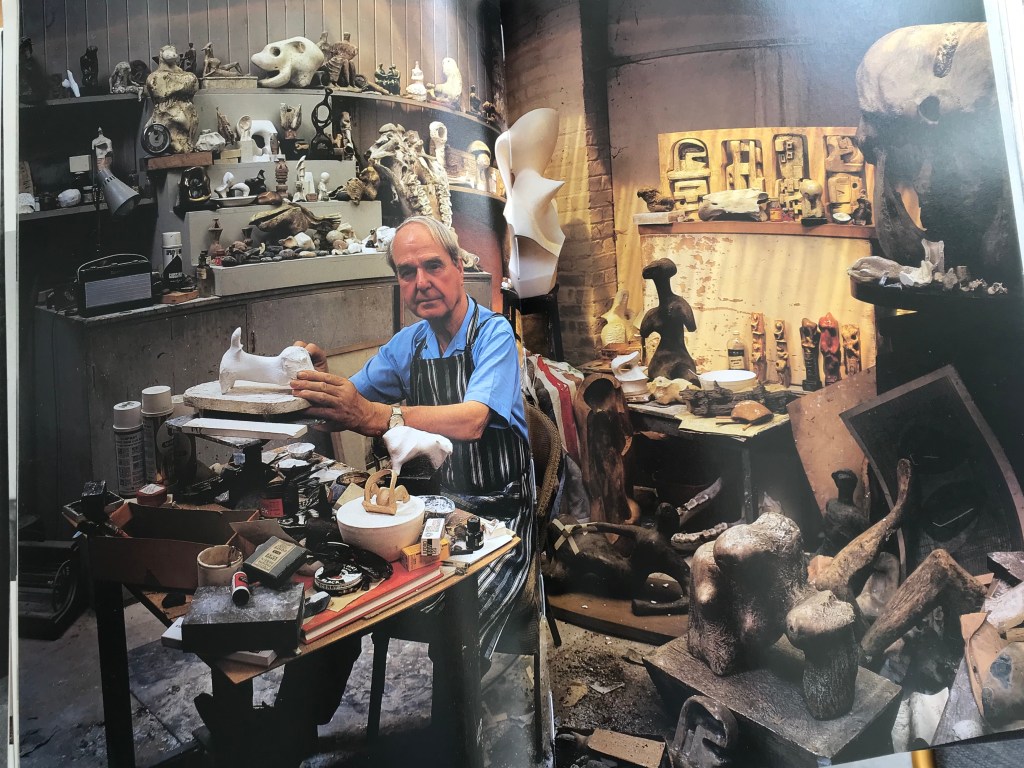
It is full of photos of the artist influences and photos of Moore at work in his cluttered studio What he writes is also very interesting and helps to inspire me.
This small section is rather insightful
“Epstein began to collect African sculptures and he encouraged me to study the primitive and Mexican sculpture at the British Museum, all of which influenced excited me. It was stone sculpture. I liked this active, physical side of sculpture and so began to know and enjoy stone sculpture is a very great excitement.”
I can relate to this as when I start carving out the mortar I get an excitement of what might be revealed from within.
I also liked this bit of writing by by Henry Moore and the nature of masks
“Masks isolate the facial expression, enabling you to concentrate on the face alone. They have, of course, been used throughout history, particularly as theatrical devices. Although the back of the head can be as beautiful and as interesting to sculptor, it can’t be as expressive, in the ordinary sense of the word, as the face.”
He then goes on to talk about masks he has sculpted
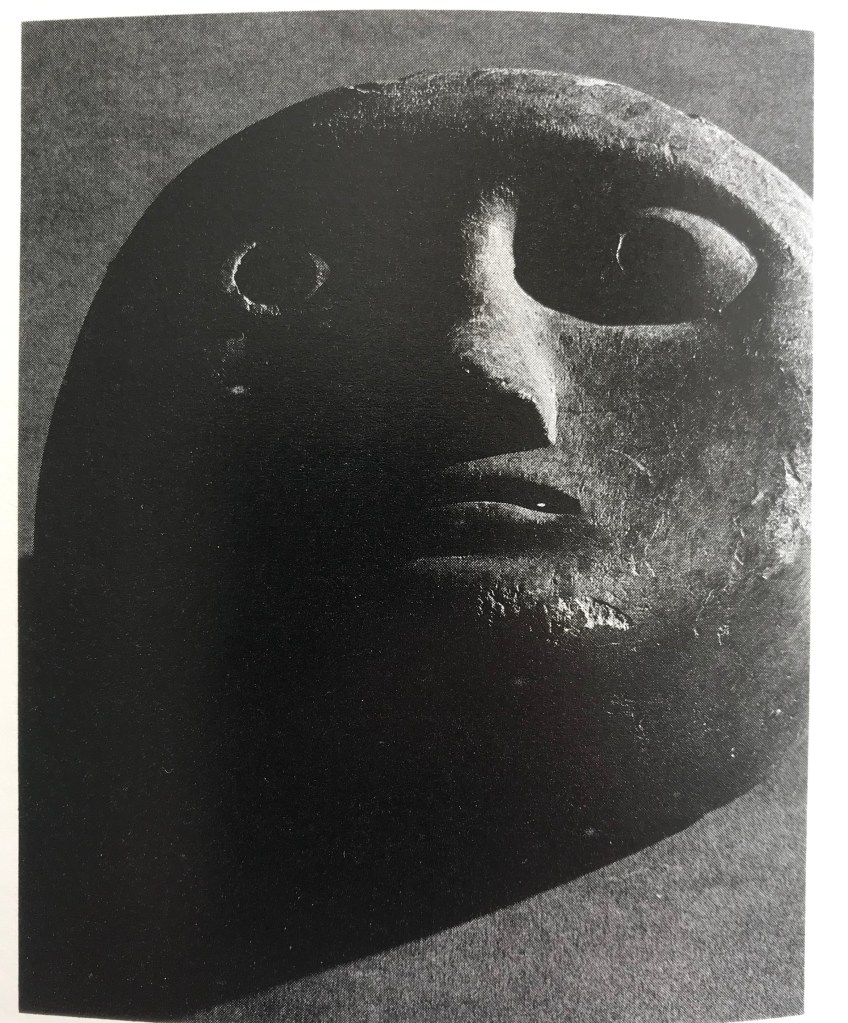
“In this mask wants to give the eyes tremendous penetration and to make them stare, because it is the eyes which most easily express human emotion. In other masks, I used the asymmetrical principle in which one eye is quite different from the other, and the mouth is at an angle bringing back the balance. I had noticed this in some of the Mexican masks, and I began to find it in reality in all faces.
And as I began to find out that, in nature, living things, because of the effect of their environments, are never perfectly symmetrical, this principle became fundamental to my work. You will find in everyone’s face that one eye is different from the other, or the mouth is not quite horizontal, one nostril is a little higher than the other, the forehead comes out a little further on one side than the other.
And it is when you come to look at a person’s face with acute observation that you will find these many small variations that make all the difference between a really sensitive portrait and a dull one.”
This section made a lot of sense to me, for many years I’ve tried to gain a form of symmetry within my work but somehow always seemed to fail, in some ways Moore validates the lack of symmetry as this makes a piece of work more human and helps it to gain a spark of life, now when I am stressing out over head carving not looking symmetrical and will keep his words in mind.
 The Art and musings of Jeffrey Knopf